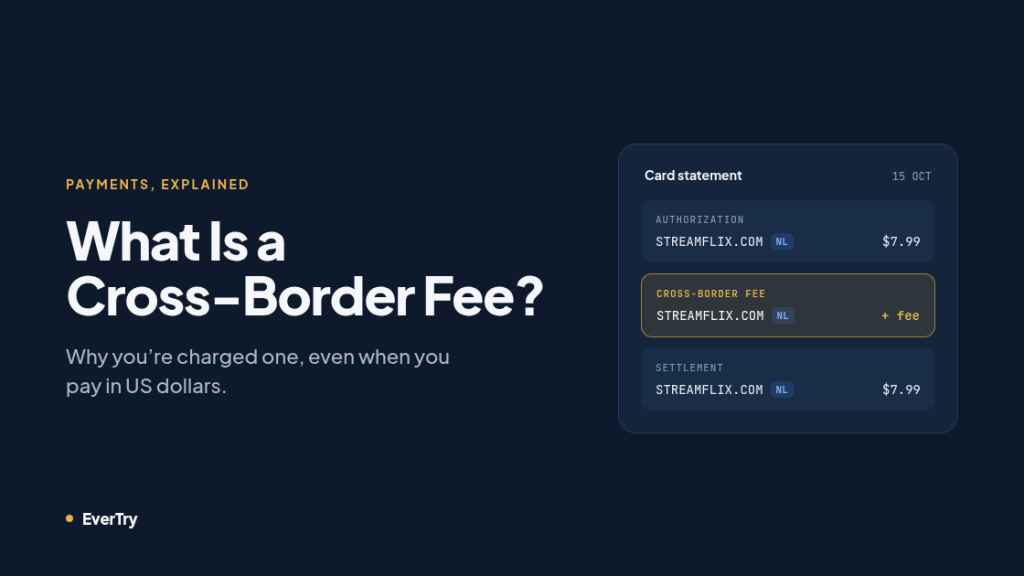
A cross-border fee is a small extra charge added when you pay a business whose payment is handled in a different country from where your card was made. It’s about countries, not the type of money. That’s why you can still be charged one when you pay in US dollars.
Here’s an easy way to picture it.
Imagine your money is going on a trip. It leaves your card’s home country and travels to the shop’s bank. If it has to cross a border on the way, it pays a small toll.
That toll is the cross-border fee.
This guide explains, in plain words:
- Why you got charged one
- How to spot it before you pay
- How it’s different from other fees
- What you can do about it
What is a cross-border fee?
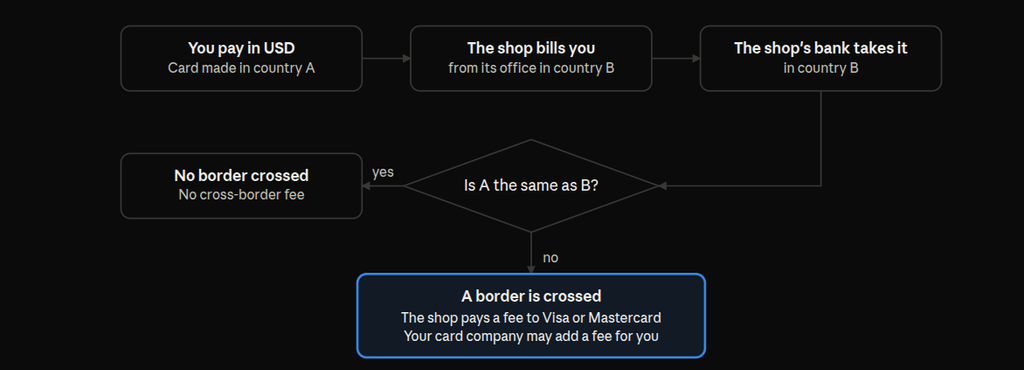
A cross-border fee is a charge for moving a card payment from one country to another. It is added when your card’s home country and the shop’s payment country are not the same.
Every card payment has five players. Think of them like this:
| Player | The simple picture | The real name |
|---|---|---|
| You | The traveller with the money | Cardholder |
| Your card company | Your money’s home | Card issuer |
| The shop | Where the money is going | Merchant |
| The shop’s bank | The shop’s money home | Acquirer |
| Visa or Mastercard | The road between them | Card network |
When you pay, your money travels down the road from your card’s home to the shop’s bank.
- Same country? No border. No toll.
- Different countries? The money crosses a border. A toll may be added.
That’s really all a cross-border fee is.
Why am I getting a cross-border fee?
You’re getting a cross-border fee because the shop handled your payment in a different country from where your card was made. This happens even if you never left home.
There are three usual reasons:
- The shop bills you from another country. Many big brands charge customers through an office abroad.
- The shop’s bank is in another country. The shop may be local, but its bank isn’t.
- You’re travelling. You paid in a shop in another country.
What it looks like on your statement
The fee often shows up as its own small line, close to the main charge. Here’s an example for a monthly streaming plan:
| What you see | Amount | When |
|---|---|---|
| Authorization at STREAMFLIX.COM Amsterdam NL | $7.99 | 15 Oct, 00:47 |
| Cross-border transaction at STREAMFLIX.COM Amsterdam NL | small fee | 15 Oct, 19:55 |
| Settlement at STREAMFLIX.COM Amsterdam NL | $7.99 | 15 Oct, 20:01 |
Example only. The shop name is made up.
See the NL at the end? That means the Netherlands. The card in this example was made somewhere else, so the payment crossed a border.
You may also notice the $7.99 appears twice. That’s normal. The first line is the shop asking for the money (authorization). The second is the money actually moving (settlement). You only pay once.
“But I paid in dollars!” Why that doesn’t stop the fee
This is the part that confuses most people.
A cross-border fee is about where the money goes, not what kind of money it is.
Paying in US dollars doesn’t help if the shop’s bank is in another country. As one US bank puts it, purchases from cross-border merchants “even if priced in U.S. dollars” may trigger a fee if they’re processed through a non-U.S. bank.
Examples from around the world
| Your card was made in… | The shop bills you from… | Does the payment cross a border? |
|---|---|---|
| United States | United States | No |
| United States | Netherlands | Yes |
| Kenya | United States | Yes |
| India | Ireland | Yes |
| Brazil | Brazil (the shop has a local office) | No |
Important: your card’s “home” is the country where the card was made, not where you live. This matters for virtual dollar cards. Many are made (issued) in a different country from the one you live in.
Whether a cross-border transaction means a fee for you depends on your card company. More on that below.
Why does one subscription charge it, but another doesn’t?
Because different companies bill you from different places.
One streaming service might bill you from its US office. Another might bill you from its European office. Same type of service, same dollars, different country.
Services that often bill people outside the US from abroad include:
- Streaming and music apps
- App stores and in-app purchases
- AI tools and software subscriptions
- Cloud hosting and developer tools
- Online ads
Companies can change where they bill from, so check your own statement rather than relying on a list.
How can I tell if I’ll be charged before I pay?
You can usually tell by finding out which country the shop bills you from. Here’s how, in four steps:
- Look at the last letters of the shop’s name. Check your statement or your card app. The last two letters are often a country code, like NL or US.
- Read the shop’s terms. Search the terms page for “you are contracting with”. It names the company billing you and its country.
- Watch the first small charge. Free trials and sign-ups often start with a tiny test charge. If a cross-border line appears next to it, the full charge will probably get one too.
- Check your card app before you subscribe. Many card apps show their fees before you pay.
Country-code cheat sheet
| Letters at the end | Country |
|---|---|
| US | United States |
| NL | Netherlands |
| IE | Ireland |
| GB | United Kingdom |
| LU | Luxembourg |
| SG | Singapore |
| DE | Germany |
| CA | Canada |
Watch out for state codes. US shops often add their state before “US”. So “CAUS” or “CA US” means California, United States, not Canada. “NJUS” means New Jersey, United States.
Who charges the cross-border fee: Visa, the shop, or my bank?
There are two different charges, and they go to two different people.
1. The road charges the shop. Visa and Mastercard charge the shop’s side when a payment crosses a border. Visa calls its fee the International Service Assessment. Mastercard calls its fee a cross-border assessment. The shop pays these, not you.
2. Your card company may charge you. Your card company (the company that gave you your card) may add its own fee for cross-border payments. This is the one you see on your statement.
So, does Visa charge cross-border fees? Yes, but to businesses. You never pay Visa directly. If you see a fee, it came from your card company.
In one line: the road charges the shop; your card company may charge you.
How much is a cross-border fee?
The fee shops pay to Visa or Mastercard is usually around 0.6% to 1.4% of the payment. What you pay depends on your card company.
What shops pay (network fees)
| Network | When the payment is settled in USD | When it’s settled in another currency | Source |
|---|---|---|---|
| Mastercard | 0.6% | 1.0% | Pay.com, Jun 2026 |
| Visa (US shops) | 1.0% | 1.4% | Checkout.com, Sep 2023 |
| Visa (Canadian shops) | 0.68% (in CAD) | 1.13% to 1.19% | Fiserv Canada, 2026 |
These rates change by country and over time. Check current numbers before relying on them.
Notice something? Currency still matters a little. It doesn’t decide whether there’s a cross-border fee, but it can change how big the shop’s fee is.
What you might pay (card company fees)
Your card company sets its own fee, and they’re all different. Most charge a small percentage of the payment.
Here’s a simple example. Say your card company charged 2% (this is an example, not a real price):
| Your subscription | Fee per month | Fee per year |
|---|---|---|
| $10 a month | $0.20 | $2.40 |
Small, but it adds up across many subscriptions.
The best way to know your real fee: look in your card app or your card’s fee page before you pay.
Is a cross-border fee the same as a foreign transaction fee?
Not quite. A cross-border fee is about where the payment goes. A currency conversion fee is about which money you use. A foreign transaction fee is a name some card companies use for either one, or both together.
| Fee | What causes it | Who sets it | Can it happen when you pay in your card’s own currency? | Where you’ll see it |
|---|---|---|---|---|
| Cross-border fee | The payment crosses a border | Visa or Mastercard (for shops), your card company (for you) | Yes | Often its own line on your statement |
| Foreign transaction fee | A foreign purchase (each card company defines it) | Your card company | Sometimes | Its own line, or added to the purchase |
| Currency conversion fee (FX markup) | Changing one currency into another | Your card company, or the shop if you let it convert | No | Often hidden in the exchange rate |
| Wire transfer fee | Sending money bank-to-bank | Your bank | Yes | On a bank transfer, not a card payment |
You can pay more than one of these on the same purchase. For example, paying a European shop in euros with a dollar card could mean a cross-border fee and a conversion fee.
Remember it like this: cross-border = where. Conversion = which money. Wire fee = a different thing altogether.
What is considered a cross-border payment?
A cross-border payment is any payment where the money leaves one country and lands in another. Everyday examples:
- A subscription billed from another country (streaming, music, software)
- Online shopping on a website based abroad
- Paying while travelling, in a shop, hotel or taxi
- Sending money to family or a business in another country
How big is the cross-border payments world?
Very big. The International Monetary Fund estimated that cross-border payments approached about $1 quadrillion in 2024. That’s a thousand trillion dollars, counting traditional and crypto payments. Your monthly subscription is a tiny part of it.
How do I avoid or reduce cross-border fees?
You can’t always avoid them, because the shop decides where it bills you from. But you can often make them smaller, or at least see them coming.
If you’re paying with a card
- Check the country code first. Use the steps above before you subscribe to something new.
- Try your app store. Some services cost the same through your phone’s app store, which may bill you from a different country. Compare before you choose.
- Pay yearly instead of monthly. If your card company adds a flat amount to each payment, one yearly payment means one fee instead of twelve.
- Say no to converting at checkout. If a foreign shop offers to charge you in your own currency, choose the shop’s currency instead. Shop-side conversion often uses a worse rate. (This cuts conversion costs, not the cross-border fee.)
- Use a card that shows its fees upfront. For example, EverTry shows its card fees in the app, so you can check them before you subscribe instead of finding out on your statement.
If you run a business
Shops pay network cross-border fees on foreign cards. The usual ways to lower them are:
- Local acquiring: take payments through a bank in your customer’s country.
- A local company: set up a business in a big market so payments there count as local.
- A merchant-of-record service: let a company that’s already local in that market sell on your behalf.
The honest part: if a shop bills you from abroad, there may be no way around the fee. Knowing about it is still better than being surprised.
Which cards or banks don’t charge cross-border fees?
Some cards don’t charge them, but it changes from card to card and country to country. Instead of trusting a list, check your own card for these three things:
- The words “no foreign transaction fee” in the card’s terms or fee page.
- What “foreign” means to them. Some cards waive the fee only when you pay in another currency. A cross-border payment in your card’s own currency can still be charged.
- Whether fees are shown before you pay, in the app, or only later on your statement.
Can I get a cross-border fee refunded?
Usually not, if the fee was charged correctly. It’s a real cost of the payment crossing a border.
There are two times it’s worth asking:
- The shop refunded your purchase. The purchase money comes back, but the fee may not come back on its own. Ask your card company what happens to it.
- You think it’s a mistake. For example, if the shop is local and the country code says so. Contact your card company’s support and share the statement line.
If you use EverTry, its human support team is available 24/7, every day of the year, to look at any charge you’re unsure about.
Frequently asked questions
Why does Netflix charge me a cross-border fee?
Netflix often bills customers outside the US from its office in the Netherlands. Your statement may show “Amsterdam NL”. If your card was made in another country, the payment crosses a border, so your card company may add a cross-border fee, even if you pay in dollars.
Why do I see two charges for one payment?
The first line is an authorization: the shop checking the money is there. The second is the settlement: the money actually moving. They’re often hours or days apart. You only pay once. A separate small line nearby may be the cross-border fee.
Do virtual cards get cross-border fees?
Yes, they can. A virtual card works like a plastic card. Its “home” is the country where it was issued. If the shop bills you from a different country, the payment crosses a border, just like with a plastic card.
Do cross-border fees apply to Apple Pay and Google Pay?
Yes, they can. Apple Pay and Google Pay use the card saved in your phone. The fee depends on that card and the shop’s country, not on how you tapped or clicked.
Do debit cards have cross-border fees too?
They can. Debit, credit, and prepaid cards all travel on the same Visa or Mastercard road. Whether you pay a fee depends on your card company’s rules.
Why am I getting charged a foreign transaction fee?
Most often, the shop processed your payment in another country, or the payment was in another currency. Check the country code at the end of the shop’s name on your statement, and look at your card’s fee page for how it defines “foreign”.
Is a cross-border fee a scam?
No. It’s a normal fee in card payments. But if you don’t recognise the shop next to the fee, contact your card company straight away.
The one thing to remember
If the shop’s money home is in a different country from your card’s home, a small toll may be added. Look at the letters at the end of the shop’s name to find out. And check your card app to see the toll before you pay.
Information current as of October 2026. Fees and billing countries can change. Always check with your card company and the shop.
Sources
- TD Bank: What to know about foreign transaction fees
- Checkout.com: What is the ISA fee?
- Pay.com: What is a cross-border fee?
- Fiserv Canada: Pass-through fees
- IMF Working Paper WP/25/120: Global Cross-Border Payments: A $1 Quadrillion Evolving Market? (June 2025)
Matt Aluya is the founder of EverTry. A software engineer focused on virtual card issuance and stablecoin settlement for cross-border payments in emerging markets. LinkedIn · matt.aluya@evertry.co