
Payment rails are the roads money travels on. When you tap a card, send a bank transfer, or pay a bill, your money doesn’t fly straight to the other person. It moves along a fixed path that banks and payment networks run, with its own rules. That path is the payment rail.
Every rail does the same four jobs. It starts the payment, carries the message, settles the money between banks, and puts it in the other person’s account. What changes from rail to rail is how fast it goes, what it costs, and where it can reach.
You already use rails every day:
- In the US, your salary probably arrives over ACH.
- In Nigeria, most bank transfers move over NIP.
- In Kenya, millions of people pay each other over M-Pesa.
- Online, your card payment travels over Visa or Mastercard.
This guide explains how rails work, the main types, and why the rail behind a payment decides whether it lands in seconds, takes three days, or gets declined.
What is a payment rail?
A payment rail is the system that actually moves money from one bank or account to another. It includes the technology, the rules, and the banks that agree to follow those rules.
Picture a road:
- Your money is the car.
- The rail is the road.
- The network’s rules are the traffic laws.
- Fees are the tolls.
- Settlement time is how long the trip takes.
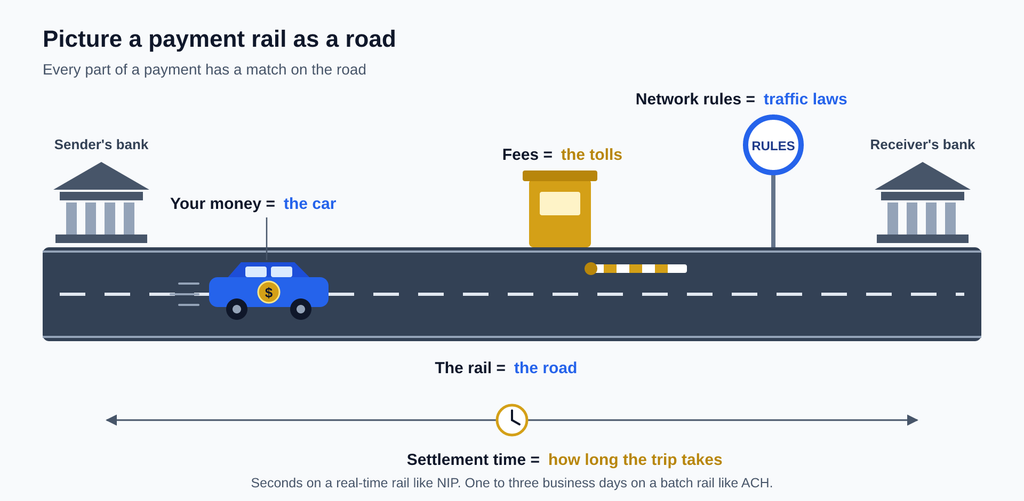
Some roads are highways that never close. Others are country roads that only open on weekdays. Some only run inside one country. A few cross the whole world.
The one-question test: is it a rail?
People mix up rails with the apps and companies that use them. Ask one question: does the money actually settle between banks or institutions here?
- If yes, it’s a rail. Examples: ACH, NIP, Faster Payments, M-Pesa.
- If it only sends instructions, it’s a messaging network. Example: SWIFT.
- If it sits on top of other rails, it’s a platform or wallet. Examples: PayPal, Apple Pay, your banking app.
Where the rail sits in a payment
A single payment passes through several layers. The rail sits at the bottom, doing the heavy lifting.
| Layer | What it does | Simple picture | Examples |
|---|---|---|---|
| Payment method | What you pay with | The ticket | Card, bank transfer, mobile money |
| App or wallet | Where you start the payment | The front door | Banking app, Apple Pay |
| Gateway | Takes payment details at checkout | The cashier | A website’s checkout page |
| Processor | Sends the payment to the right network | The delivery driver | The company behind the checkout |
| Network | Writes the rules and connects banks | The traffic authority | Visa, Mastercard, NIBSS |
| Rail | Moves and settles the money | The road | ACH, NIP, SEPA, M-Pesa |
You’ll often see “payment network” and “payment rail” used as if they mean the same thing. Strictly, the network is the group that runs and governs the system, and the rail is the infrastructure that moves the money. In everyday talk, both words point to the same place: the road under your payment.
How payment rails work: the 4 steps
Every rail follows the same four steps, whatever country or currency it uses. Let’s follow Ada as she sends her friend Tunde ₦5,000.
- Initiation. Ada opens her banking app, types Tunde’s account number and taps Send. Her bank checks that she has the money.
- Transmission. Ada’s bank sends a payment message over the rail to Tunde’s bank. The message says who pays, who gets paid, and how much.
- Clearing and settlement. The rail checks the message and moves the actual value between the two banks. Banks usually settle through accounts they hold at the central bank or a clearing house.
- Posting. Tunde’s bank adds ₦5,000 to his account, and he gets an alert.
On a real-time rail like NIP, all four steps happen in seconds. On a batch rail like ACH, steps 3 and 4 can take one to three business days.
Three terms that confuse people
- Authorization vs. settlement. When you pay by card, the bank says “yes” in seconds. That’s authorization. The money itself moves between banks later, often in a daily batch. That’s settlement.
- Batch vs. real-time. Batch rails collect payments and process them in groups at set times, like a school bus. Real-time rails send each payment on its own, the moment you tap, like a motorbike courier.
- Gross vs net settlement. Gross means each payment settles one by one, in full. Net means banks add up everything they owe each other and settle only the difference at the end.
The 8 main types of payment rails
Rails come in eight main families. Each one solves a different problem: cheap, fast, big, cross-border, or always open.
1. Batch bank transfer rails
Think of a school bus. It waits, picks up many payments, and leaves at set times. Batch rails are cheap and reliable, but slow. They suit payroll, bills, and direct debits.
- Examples: ACH (US), Bacs (UK), SEPA Credit Transfer (Europe).
- Scale: The US ACH network moved about $93 trillion in 2025.
2. High-value (wire and RTGS) rails
Think of an armoured truck. It carries one big load at a time and delivers it straight away. RTGS stands for real-time gross settlement. Central banks run these rails for large, urgent payments between banks.
- Examples: Fedwire and CHIPS (US), CHAPS (UK). Almost every central bank, including the Central Bank of Nigeria, runs its own RTGS system.
3. Real-time payment rails
Think of a motorbike courier who works day and night. Real-time rails move each payment in seconds, 24 hours a day, 7 days a week. Once the money lands, you usually can’t pull it back.
- Examples: FedNow and RTP (US), Faster Payments (UK), SEPA Instant (Europe), UPI (India), Pix (Brazil), NIP (Nigeria), PesaLink (Kenya), GhIPSS Instant Pay (Ghana), InstaPay (Egypt), PayShap (South Africa).
- Fact: NIBSS Instant Payments launched in 2011 and now carries over 90% of Nigerian bank-to-bank transfers.
4. Card rails
Think of a toll highway built by a private company. Card networks set the rules that connect your bank (the issuer) to the shop’s bank (the acquirer). Approval takes seconds. Settlement happens later, usually in a daily batch. If something goes wrong, you can ask for a chargeback.
- Global card rails: Visa, Mastercard, American Express.
- Domestic card rails: Verve (Nigeria), gh-link (Ghana), RuPay (India). These work mainly at home, which is why they often fail at foreign checkouts.
5. Mobile money rails
Think of a wallet that lives on your phone number. You don’t need a bank account. Mobile money operators keep their own ledger and settle with banks behind the scenes.
- Examples: M-Pesa (Kenya), MTN Mobile Money, Airtel Money, Orange Money.
- Watch out: A country is not a rail. Kenya, Ghana and Uganda run big mobile money rails. Nigeria pays out to bank and fintech accounts over NIP instead.
6. Cross-border rails and messaging (SWIFT)
Think of a relay race. When money crosses borders, it often passes through a chain of “correspondent” banks. Each bank hands it to the next, checks it, and sometimes takes a fee.
SWIFT is the messaging system those banks use to talk. It sends the instructions; it doesn’t move the money itself. It connects over 11,000 institutions in more than 200 countries. Since 22 November 2025, SWIFT payment messages between banks use a newer, richer data standard called ISO 20022.
7. Regional rails
Think of a shared road between neighbouring countries. Regional rails let people pay across borders in a region as easily as at home.
- SEPA connects euro payments across 36 European countries.
- PAPSS (the Pan-African Payment and Settlement System) launched in January 2022. It lets people pay across African borders in their own local currencies, without routing through US dollars first. The Central Bank of Nigeria directed all banks in Nigeria to adopt it.
8. Blockchain and stablecoin rails
Think of a public notebook that everyone can read, which never closes. Blockchain rails record each payment on a shared ledger instead of a central clearing house. Stablecoins like USDT and USDC are digital dollars that travel on these rails.
- Examples: Tron, Ethereum, Solana, Base, Polygon, Stellar.
- Good: Open 24/7, crosses borders in minutes.
- Careful: Payments can’t be reversed. Send to the wrong address and the money is usually gone.
What about PayPal, Apple Pay and banking apps? These are cars, not roads. They give you a nice way to start a payment, then use card rails, bank rails or their own internal ledger underneath.
Payment rails around the world
Each country builds its own roads. Here are the main rails people use in different parts of the world.
| Country or region | Everyday transfers | Cards | Big or urgent payments | Mobile money |
|---|---|---|---|---|
| United States | ACH, RTP, FedNow | Visa, Mastercard, Amex | Fedwire, CHIPS | — |
| United Kingdom | Faster Payments, Bacs | Visa, Mastercard | CHAPS | — |
| Eurozone | SEPA, SEPA Instant | Visa, Mastercard, local schemes | T2 (ECB) | — |
| India | UPI, IMPS | RuPay, Visa, Mastercard | RTGS | Wallets on top of UPI |
| Brazil | Pix | Visa, Mastercard, Elo | STR (central bank) | — |
| Nigeria | NIP (run by NIBSS) | Verve, Visa, Mastercard | CBN RTGS | Fintech wallets paid out over NIP |
| Kenya | PesaLink | Visa, Mastercard | KEPSS (central bank) | M-Pesa, Airtel Money |
| Ghana | GhIPSS Instant Pay | gh-link, Visa, Mastercard | GIS (central bank) | MTN MoMo, Telecel Cash |
| South Africa | PayShap, EFT | Visa, Mastercard | SAMOS (central bank) | — |
| Egypt | InstaPay | Meeza, Visa, Mastercard | RTGS | Mobile wallets |
| Across Africa | PAPSS | — | — | — |
| Worldwide | SWIFT (messaging) + correspondent banks | Visa, Mastercard | — | Stablecoins (USDT, USDC) |
In Nigeria and Ghana, the domestic card schemes (Verve and gh-link) run on local rails. That’s great at home but often causes a decline on foreign websites, which expect international card rails.
Payment rails compared
No rail is the “right” one for everything. Each trades speed, cost, and safety differently.
| Rail type | How fast | When open | Can you reverse it? | Who usually loses if there’s fraud | Relative cost | Best for |
|---|---|---|---|---|---|---|
| Batch bank (ACH, BACS) | 1–3 business days | Business days | Sometimes, within set windows | Depends on the rule | Low | Salaries, bills, subscriptions |
| Wire / RTGS | Minutes to same day | Business hours | Rarely | Sender | High | Large or urgent payments |
| Real-time (NIP, UPI, Pix, FedNow) | Seconds | 24/7 | Usually no | Sender | Low | Sending money to people, payouts |
| Cards (Visa, Mastercard) | Approved in seconds, settled in 1–2 days | 24/7 | Yes, through chargebacks | Usually the merchant | Medium to high | Shopping online and in stores |
| Mobile money (M-Pesa, MoMo) | Seconds | 24/7 | Limited | Varies by operator | Low to medium | Everyday payments without a bank account |
| Cross-border via SWIFT and correspondent banks | 1–5 business days | Business hours in each country | Hard | Sender | High | International bank transfers |
| Regional (SEPA, PAPSS) | Seconds to 1 day | Varies | Varies | Varies | Low to medium | Payments inside a region |
| Stablecoins on blockchains | Seconds to minutes | 24/7 | No | Sender | Low to medium (network fees vary) | Cross-border transfers, saving in dollars |
Costs depend on your provider, the amount, and the currency. The table shows how rails compare to each other, not exact fees.
One payment, several rails: a real example
Most payments use more than one rail. Here’s what happens when Chidi in Lagos pays $20 for a US software subscription.
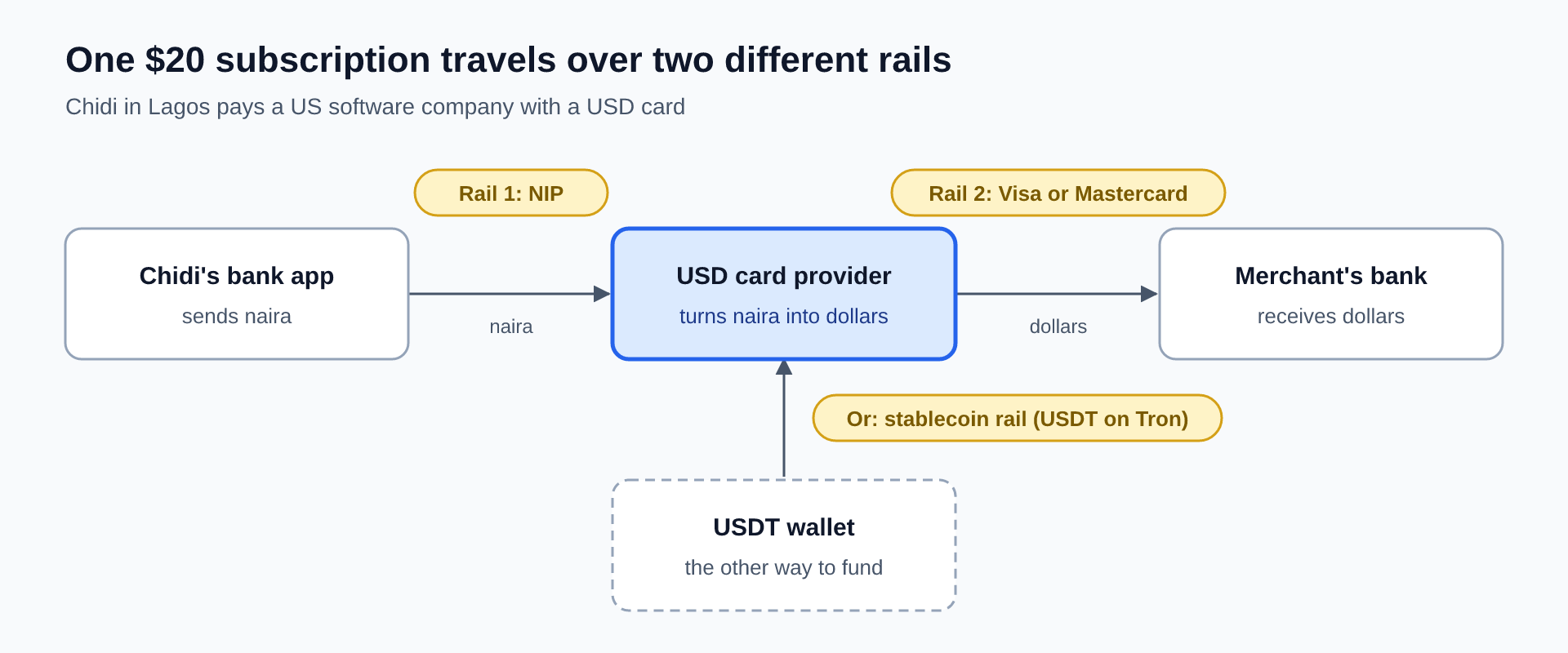
- Chidi tops up his USD card. He sends naira from his bank app. The naira travels over NIP, Nigeria’s real-time rail, and lands in seconds.
- The card provider converts the money. It turns his naira into dollars and loads them onto the card.
- Chidi pays at checkout. The software company’s checkout sends the payment over the Visa or Mastercard card rail. Chidi’s card issuer approves it in seconds.
- The banks settle later. Over the next day or two, the card network settles the dollars between the card issuer and the merchant’s bank.
Chidi could also skip step 1 and fund the card with USDT. Then the first road is a stablecoin rail, like Tron, instead of NIP.
This is how a virtual dollar card from EverTry works for people whose local cards get declined abroad. You fund it in your local currency or in stablecoins, and it pays over Visa or Mastercard’s international rails.
Why payments get declined or delayed
Most payment problems are rail problems. Here are the five you’ll meet most often.
- The rails don’t match. A domestic card like Verve or gh-link runs on a local rail. A US or European website expects an international card rail. The checkout can’t reach your bank, so it declines.
- The rail is closed. Batch rails and wires only run on business days. Send a transfer on Friday evening, and it may not move until Monday.
- Too many hops. A cross-border transfer can pass through two or three correspondent banks. Each one checks it, holds it, and may charge a fee. That’s why international transfers can take days and arrive short.
- Currency and compliance checks. When money changes currency or crosses a border, banks run extra checks. A missing detail or an unusual amount can pause the payment.
- Wrong details on a rail you can’t reverse. Real-time and blockchain rails move money in seconds, but they rarely pull it back. Always check the account number or wallet address before you send.
Quick fix: If a foreign site keeps declining your card, the problem is usually the rail, not your balance. Paying with a card that runs on Visa or Mastercard’s international rails often solves it.
Where payment rails are heading
The roads are getting faster, smarter and more connected. Four changes stand out in 2026.
- Instant is becoming normal. Countries keep launching real-time rails that never close. NIP, UPI and Pix show how fast people switch when payments land in seconds.
- Better payment messages. Since 22 November 2025, cross-border bank instructions on SWIFT travel only in the ISO 20022 format. Richer data means fewer payments get stuck because of missing details. It doesn’t make settlement itself instant, though.
- Africa is connecting its own roads. PAPSS lets people and businesses pay across African borders in local currencies. Banks are now adding it inside their mobile apps, though access is still uneven.
- Stablecoins are joining the card rails. Visa’s stablecoin settlement program hit an annualized run rate of about $7 billion in April 2026, up roughly 50% in a quarter, across nine blockchains. That’s still only about 0.05% of Visa’s total volume, so cards and bank rails aren’t going anywhere soon.
For everyday users, the future is a mix. You’ll still use bank and card rails, but more apps will let you hold or move stablecoins too. EverTry, for example, supports USDT and USDC across many networks, including Tron, Ethereum, Solana, BSC, Base, Polygon, and Stellar, and lets you spend them through a Visa or Mastercard card.
Frequently asked questions
What is a payment rail in simple words?
A payment rail is the road your money travels on between banks or accounts. It has its own rules, speed, and cost. ACH, NIP, Visa, and M-Pesa are all payment rails.
What is an example of a payment rail?
ACH in the US, Faster Payments in the UK, SEPA in Europe, UPI in India, Pix in Brazil, NIP in Nigeria, and M-Pesa in Kenya are all payment rails. Visa and Mastercard are card rails that work in most countries.
How do payment rails work?
Every rail follows four steps. You start the payment (initiation). Your bank sends a message to the other bank (transmission). The rail moves the value between the banks (clearing and settlement). Then the money appears in the other account (posting).
Is PayPal a payment rail?
No. PayPal is a platform that sits on top of rails. When you pay with PayPal, the money moves over card rails like Visa and Mastercard, or bank rails like ACH and SEPA, plus PayPal’s own internal ledger.
Is Zelle a payment rail?
No. Zelle is a payment network owned by a group of US banks. It sends the payment message instantly, but the money between banks settles over other rails. For years, that was ACH. Since 2021, banks can also settle Zelle payments over the RTP network.
Is SWIFT a payment rail?
Not quite. SWIFT is a messaging network. It carries the instructions for a cross-border payment between banks, but the money itself moves through the banks’ accounts with each other (correspondent banking).
Is M-Pesa a payment rail?
Yes. M-Pesa keeps its own ledger and settles payments on it, so it works as a mobile money rail. That’s different from PayPal, which rides on other rails.
What are the three types of payment systems?
There’s no single official list. A simple way to group them is:
- Cash and paper, such as notes and cheques.
- Card payments, which run on card rails.
- Account-to-account payments, such as bank transfers and mobile money.
Central banks also split systems into large-value systems (for big payments between banks) and retail systems (for everyday payments).
What are the 7 methods of payment?
Common payment methods are cash, debit cards, credit cards, bank transfers, mobile money, digital wallets and cryptocurrency or stablecoins. A payment method is what you pay with. The rail is the road it travels on underneath.
What are the four types of payments?
A common way to group payments is cash, cheques, cards and electronic bank transfers. Mobile money and stablecoins are now often added as a fifth and sixth.
Which payment rail is the fastest?
Real-time rails like NIP, UPI, Pix, FedNow and Faster Payments settle in seconds, 24/7. Card payments are approved in seconds too, but the money settles between banks a day or two later.
Can I choose which rail my payment uses?
Usually your bank or app picks for you. But you choose indirectly when you pick a method. A bank transfer, a card payment, and a stablecoin transfer each take a different road.
What are some widely used payment platforms in Africa, Asia and Latin America?
Platforms are apps that sit on top of rails. Here are some widely used ones by region, in no particular order:
| Region | Widely used platforms | Main rails underneath |
|---|---|---|
| Africa | M-Pesa, MTN MoMo, OPay | Mobile money, NIP and other national switches, Visa and Mastercard |
| Asia | Alipay, WeChat Pay, GCash, Paytm | UPI, national instant rails, card rails |
| Latin America | Mercado Pago, Nubank, PicPay | Pix, national bank rails, card rails |
| Africa, Asia and Latin America | EverTry: Visa and Mastercard cards that work in 180+ countries, funded in local African and Asian currencies, USDT, USDC or BTC, plus transfers to 160 countries | Card rails, local bank and mobile money rails, stablecoin rails |
Sources
- NIBSS, PesaLink, GhIPSS and Africa’s national payment switches — All Business Africa
- How PAPSS is fixing Africa’s cross-border payments, four years on — TechCabal
- FirstBank, PAPSS and the race to own Africa’s payment rails — Nairametrics
- African payout rails: M-Pesa, MoMo, Airtel Money and NIP — Eversend
- Swift ISO 20022 goes live as deadline passes — East & Partners
- Visa adds Polygon, Base support as stablecoin settlement run rate hits $7B — Cointelegraph
- Visa’s $7B stablecoin network goes multi-chain — BlockEden
- Zelle payments now able to be cleared and settled over RTP — ABA Banking Journal
- Payment rails: ACH, SWIFT, RTP and other networks explained — Tipalti
- Payment rails explained — Slash
The EverTry Editorial Team covers personal finance, fintech, payments, and cross-border money transfers. Drawing on our experience building payment products for a global audience, we work to make complex financial topics clear, practical, and accessible, helping individuals and businesses make informed decisions about managing and moving money.