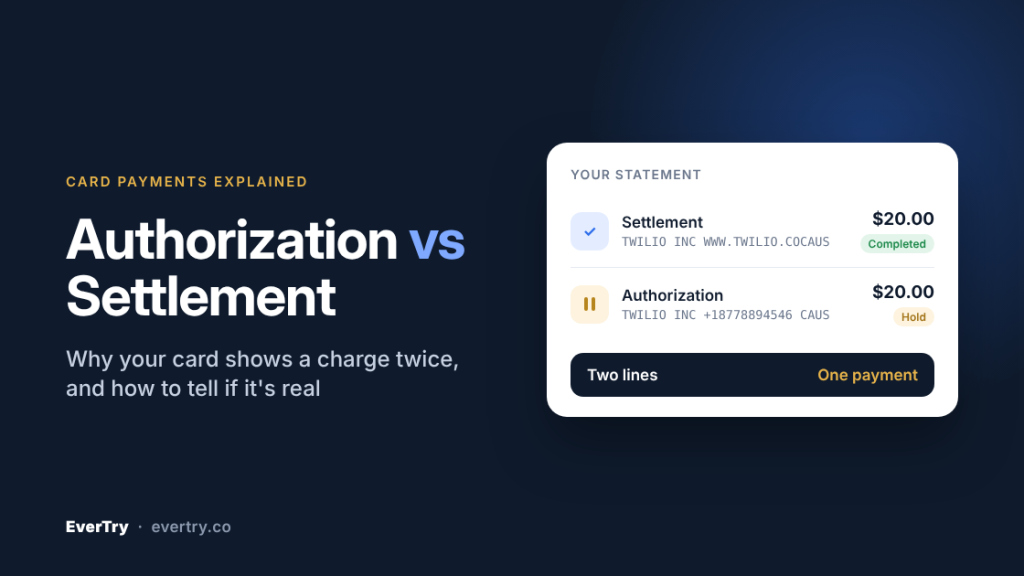
If one purchase shows up twice on your card, you were almost certainly charged once.
The first line is an authorization. The merchant asks your card issuer to place a hold on the funds. Nothing has moved yet.
The second line is the settlement. The merchant confirms the final amount, and the money actually leaves your balance. Once it posts, the hold drops away.
Visa gives merchants 5 to 10 days to settle most charges, and most online payments settle within a day or two. A real duplicate is two settled charges for one purchase — and that is something you can dispute.
In this guide:
- What the two lines mean
- A real statement, line by line
- Why the merchant name and fees can look different
- How long holds last
- How to spot a real duplicate, and what to do
What authorization and settlement actually mean
An online card payment happens in two messages, not one. Each message can show up on your statement as its own line.
| Authorization | Settlement | |
|---|---|---|
| What it does | Holds the money | Moves the money |
| When it happens | The moment you pay | Usually hours to a few days later |
| How it often shows | Pending, or labelled “Authorization” | Completed, posted, or labelled “Settlement” |
| Does money leave your balance? | No, but you can’t spend it | Yes |
| What happens next | Drops off once settlement posts | Stays on your statement |
[embed: node/03f58e96-8d7a]
The pending line covers the hold. The completed line is the actual payment. You only pay once.
Here’s the full journey of one payment:
- You pay. The merchant sends an authorization request through Visa or Mastercard to your card issuer.
- Your issuer approves and holds the funds. It checks your balance and fraud rules, then reserves the amount. Your available balance drops, but nothing is paid yet.
- The merchant confirms the final amount. In the industry, this is called capture (merchant side) or clearing (card side). It’s the same step.
- The money moves and the charge posts. That’s settlement. Your issuer posts the final charge and releases the hold.
Between steps 3 and 4, both lines can sit on your statement for a short while. That overlap is the “charged twice” moment. Even one major payment processor’s documentation admits some statements “don’t always distinguish between authorizations and captured (settled) payments.”
On a funded or prepaid card, the hold matters more. It reduces what you can spend right away, even though the money only leaves once.
A real statement, line by line
Here’s what this looks like on an actual card. These lines come from a real, anonymized virtual USD card statement from September and October 2026.
Every purchase appears twice. And every amount matches to the cent.
| Merchant | Authorization | Settlement | Gap | What changed |
|---|---|---|---|---|
| Twilio | 29 Sep · $20.00 | 1 Oct · $20.00 | 2 days | Merchant name text |
| Apple | 25 Sep · $13.57 | 26 Sep · $13.57 | 1 day | Nothing |
| Vultr | 1 Oct · $24.00 | 2 Oct · $24.00 | 1 day | Nothing |
| Netflix | 15 Oct, 00:47 · $7.99 | 15 Oct, 20:01 · $7.99 | Same day | A third line appeared |
| Netflix (extra line) | — | 15 Oct, 19:55 · $0.70 | — | “Cross-border transaction” |
Anonymized from a real user statement, Sep–Oct 2026. The fee line is shown for illustration only. Check your card app for current fees.
Twilio: same $20, different name, two days apart
- 29 Sep, Authorization: $20.00 at
TWILIO INC +18778894546 CAUS - 1 Oct, Settlement: $20.00 at
TWILIO INC WWW.TWILIO.COCAUS
Same merchant, same amount. Only the text after the name changed: a phone number in the first line, a web address in the second. That’s still one $20 payment. We explain why the text changes in the next section.
Apple and Vultr: settled the next day
Apple’s $13.57 was authorized on 25 Sep and settled on 26 Sep. Vultr’s $24.00 was authorized on 1 Oct and settled on 2 Oct.
A one-day gap is the most common pattern. Many merchants send their confirmed payments in batches, often once a day.
Netflix: same day, plus a third line
Netflix authorized $7.99 just after midnight and settled it the same evening. Fast, but still two lines.
Then a small, separate line appeared: $0.70, “Cross-border transaction at NETFLIX.COM Amsterdam NL.” This isn’t part of the Netflix price. It’s a separate fee line, and it’s covered below.
Why this statement is such a clean example: every charge was priced in US dollars on a US dollar card. With no currency conversion, the pending and settled amounts match exactly.
Why the two lines can look different
The two lines don’t always look identical. There are three common reasons.
1. The merchant name changes
The authorization and the settlement are two separate messages. Each one carries its own copy of the merchant’s name and location, and they don’t always match.
Take TWILIO INC WWW.TWILIO.COCAUS and break it down:
- TWILIO INC — the merchant name
- WWW.TWILIO.CO — the location field. Online merchants often put a phone number or web address here instead of a city. The field is short, so long web addresses get cut off. (That’s why “.COM” became “.CO”.)
- CA — the state (California)
- US — the country (United States)
With no spaces between them, “CO” + “CA” + “US” runs together into “COCAUS.” Apple’s line, APPLE.COM/BILL 866-712-7753 CAUS, follows the same pattern.
The rule: match the two lines on amount, the merchant’s main name and a date within a few days. Ignore the rest of the text.
2. A separate cross-border line appears
This one surprises people most. You paid in US dollars with a US dollar card. So why a “cross-border” fee?
Because cross-border is about where the merchant is, not the currency. A payment counts as cross-border when the merchant is based in a different country from the one that issued your card (payments explainer).
Netflix is a good example. Outside the US, Netflix accounts are usually provided by Netflix International B.V., a company in the Netherlands. Netflix’s own terms warn that your card issuer may add foreign transaction fees (Netflix corporate information). That’s why the line says “Amsterdam NL.”
The fee comes from the card program, not from Netflix. That’s why it shows as its own line instead of being added to the $7.99.
On an EverTry card, card fees are shown in the app. Check there for current figures rather than relying on the example above.
3. The amount changes
In our example, every amount matched. But the settled amount can differ from the hold. Common reasons:
- Estimated holds. Hotels, car rentals, and fuel stations hold an estimate, then settle the real total.
- Tips and extras. A restaurant or delivery order can settle higher once a tip is added.
- Partial orders. If only part of an order ships, the merchant may settle less.
- Currency conversion. If the price is in a different currency from your card, exchange rates can shift the amount. Card networks now generally reuse the rate from the authorization, with some exceptions. Refunds use the rate on the day of the refund.
When the settled amount is lower, the extra held money should be released. Visa requires merchants to release the difference within 24 hours (Visa).
Normal pair or real duplicate?
The quickest test is the status of each line:
- One pending + one completed = normal. You paid once.
- Two completed for one purchase = a real duplicate. You can get it back.
For everything in between, find your situation below.
| What you see | Status | Amounts | What it usually means | What to do |
|---|---|---|---|---|
| Same merchant, two lines a day or two apart | 1 pending, 1 completed | Same | Normal authorization + settlement | Nothing. The pending line drops off soon. |
| Same as above, but the merchant text differs | 1 pending, 1 completed | Same | Normal. The two messages carry different text. | Match on amount, main name, and date. |
| Pending is higher than completed | 1 pending, 1 completed | Different | An estimated hold was adjusted (tip, hotel, fuel) | Wait for the extra to be released. |
| A small separate “cross-border” line | Completed | Small, separate | A card fee because the merchant is abroad | Check the fees shown in your card app. |
| Two pending after a failed checkout and retry | 2 pending | Same | A leftover hold from the failed attempt | Wait about a week, or ask the merchant to release it. |
| A charge disappeared, then came back as completed | Completed | Same | The hold expired before the merchant settled late | Normal, if you really made the purchase. |
| Two completed lines, one purchase | 2 completed | Same | A real duplicate | Contact the merchant first, then dispute. |
| A merchant you don’t recognize, or a random small charge | Any | Any | Possible fraud or card testing | Freeze your card and contact support now. |
How long until a hold drops?
Most online holds settle within 1–3 days. If the merchant never settles, the hold usually drops off after about a week.
The card networks set the outer limits. Since 13 April 2024, Visa has given merchants a fixed number of days to settle after an authorization (Visa).
| Type of payment | Visa deadline for the merchant | Mastercard (commonly applied) | When holds usually drop |
|---|---|---|---|
| Online purchase you make | 10 days | 7 days | About 7 days |
| Subscription or automatic charge | 5 days | 7 days | About 7 days |
| In-store purchase | 5 days | Varies | About 7 days |
| Hotel, car rental, cruise | 30 days | 30 days | About 30 days |
Visa figures from Visa’s April 2024 rules. Mastercard figures are the windows commonly applied by card issuers and processors. Exact timing varies by card provider.
The “vanishing charge” that comes back
Sometimes a hold drops off, and then the charge reappears days later as completed.
This is normal. Your card provider may release a hold after about 7 days, while the merchant still has up to 10 days to settle. When the merchant settles late, the charge posts anyway.
Tip: if a hold disappears for a purchase you know was real, don’t treat that money as spare. The charge can still arrive.
What to do if you think you were charged twice
Work through these steps in order. Most cases end at step 2.
- Wait for both lines to finish. Card providers generally can’t dispute a charge while it’s still pending. Give it a few days.
- Compare the two lines. Check status, amount, merchant name, and date. One pending plus one completed is normal.
- Find your receipt. Look for an order confirmation or email from the merchant. One receipt for two completed charges points to a real duplicate.
- Contact the merchant first. Ask them to reverse the extra charge or refund it. If they refund it, ask for the ARN (a reference number) so your card provider can trace the money.
- Contact your card provider. If the merchant doesn’t help, raise it with your card’s support team. EverTry’s support is run by people, 24/7, including holidays.
- Open a dispute in time. For Visa cards, the dispute window is usually 120 days from the transaction date. Don’t wait until the end. Your provider needs time to raise it.
- If you don’t recognize the merchant, act now. Freeze your card right away and report it. Don’t wait for anything to settle.
Reversal or refund: how each looks
| Reversal | Refund | |
|---|---|---|
| When it happens | Before the charge settles | After the charge settles |
| What you see | The pending line disappears or shrinks | A new credit line appears |
| How long it takes | Usually quick, varies by provider | Often 5–10 business days |
Special cases on funded and virtual cards
A few situations catch people out, especially on prepaid or funded cards.
- A small charge you didn’t expect. Some services check that your card is real when you add it. Visa merchants should use a $0 check for this (Visa), but small temporary holds still appear. If you don’t recognize the merchant, treat it as possible fraud.
- A failed payment, but the money is held. A declined or abandoned checkout can still leave a hold. It drops off on its own, usually within about a week.
- You froze or deleted your card, and a charge still went through. Freezing stops new payments. It doesn’t stop a payment that was already approved, because the merchant can still settle it.
- Your balance went negative. If a merchant settles more than it held, the difference can take a funded card below zero.
- A subscription keeps retrying. If a subscription payment is declined, the merchant can retry it, within limits set by the card networks.
On a funded card like EverTry’s, keep a small buffer above your subscription costs. It covers late settlements and small adjustments without declines.
If your card was issued in the US
US law adds its own rights on top of the card network rules (CFPB):
- Credit cards: dispute in writing within 60 days of the statement.
- Debit and prepaid cards: report within 60 days of the statement. The bank generally must investigate within 10 business days, longer in some cases (CFPB).
Frequently asked questions
Was I charged twice if I see a pending and a completed charge?
Almost certainly not. The pending line is the authorization, a temporary hold. The completed line is the settlement, the actual payment. Once settlement posts, the hold drops away. You’re only charged twice if two completed charges appear for one purchase.
What is the difference between authorization and settlement?
Authorization is when your card issuer approves a payment and holds the money. Settlement is when the money actually moves to the merchant and the charge posts. Authorization happens instantly. Settlement usually follows within hours to a few days.
How long does a card authorization hold last?
Most online holds settle within 1–3 days. If the merchant never settles, the hold usually drops off after about 7 days. Under Visa’s rules from April 2024, merchants have 10 days for online purchases, 5 days for subscriptions, and 30 days for hotels and car rentals.
Why is the merchant name different on the settled charge?
The authorization and settlement are separate messages, and each carries its own merchant text. One might show a phone number, the other a web address. Match the lines on amount, the merchant’s main name, and the date instead.
Why was I charged a cross-border fee on a USD purchase?
Cross-border depends on where the merchant is based, not the currency. If the merchant is registered outside the country that issued your card, the payment can count as cross-border, even in US dollars. Netflix, for example, bills many non-US accounts from the Netherlands.
Why is the final amount different from the pending amount?
Some merchants hold an estimate first, then settle the real total. Tips, hotel extras, fuel, partial orders and currency conversion can all change the amount. If the final amount is lower, the extra held money should be released.
The merchant cancelled, but the charge is still pending. What now?
Ask the merchant to confirm they’ve reversed the authorization. Visa requires merchants to release a cancelled hold within 24 hours, but your card provider may take longer to show it. If it’s still there after about a week, contact your card provider.
Do I owe the pending amount or the completed amount?
You pay the completed amount. The pending amount is a temporary hold that gets replaced when the charge settles. If the two differ, the completed amount is what the merchant actually charged.
Can I dispute a pending charge?
Usually not. Card providers generally need the charge to complete before they can open a dispute. Contact the merchant first. The exception is fraud: if you don’t recognize the charge, freeze your card and report it right away.
My payment failed, but money was deducted. Will I get it back?
Usually, yes. A failed or abandoned payment can leave a hold, but no money has moved. The hold drops off when the merchant releases it or when it expires, usually within about a week. If a completed charge appears, contact the merchant.
Disclaimer: This article is for general information only and is not financial or legal advice. Card network rules, hold times and dispute windows are accurate as of October 2026, can change, and may differ by card provider. The statement example is anonymized and shown for illustration. Fees vary; check your card app for current fees. EverTry is not affiliated with Visa, Mastercard, Twilio, Apple, Vultr or Netflix. All trademarks belong to their owners.
Matt Aluya is the founder of EverTry. A software engineer focused on virtual card issuance and stablecoin settlement for cross-border payments in emerging markets. LinkedIn · matt.aluya@evertry.co