If you’re building websites, deploying apps, or running client projects from Mauritania, Netlify makes hosting easy. The problem shows up at checkout: Netlify bills its paid plans in US dollars through a card payment, and many Mauritanian bank cards aren’t set up to complete that kind of recurring international charge. A USD virtual card is currently the most practical way around this; this guide covers Netlify’s actual pricing, why local cards struggle, and exactly how to get a working payment method.
Does Netlify Accept Payments From Mauritania?
Yes, Netlify doesn’t restrict where you sign up from. You can create an account, connect a Git repository, and deploy a site from Mauritania with no location barrier at all.
The barrier is payment, not access:
- Netlify billing runs entirely online, through a card on file.
- Paid plans require a supported card; there’s no separate “Mauritania” billing flow.
- The billing country and card details you enter need to match accurately, or the charge can fail even on a card that would otherwise work.
What Payment Methods Does Netlify Accept?
| Payment method | Works for Netlify? | Notes |
|---|---|---|
| Visa | Yes | Standard supported method |
| Mastercard | Yes | Standard supported method |
| American Express | Depends | Support can vary; confirm at checkout |
| PayPal | No | Not available for standard self-service billing |
| Bank transfer | Usually no | Generally reserved for Enterprise contracts |
In practice, this means individual developers and small teams need one thing: a debit or credit card that can settle a recurring USD charge internationally. That single requirement is where most Mauritania-based signups run into trouble.
Why Does My Mauritanian Card Fail When Paying for Netlify?
This is worth understanding properly, because “the card just doesn’t work” isn’t quite the full picture.
Netlify Charges in USD
Netlify’s subscriptions are billed in US dollars, not the Mauritanian ouguiya (MRU). A card that works perfectly for local purchases in MRU may simply not be provisioned to settle a foreign-currency charge; the two are different capabilities, not a matter of the card being faulty.
Recurring Payments Are Different From a One-Time Purchase
There’s a common misconception worth clearing up: successfully making one international payment doesn’t guarantee a subscription will work.
Recurring billing needs a few things a one-off charge doesn’t:
- The merchant must be authorized to charge the card again automatically.
- The card must support recurring transactions specifically, not just a single swipe.
- The card must handle international billing every cycle, not just once.
This is true for Netlify, and it’s equally true for GitHub, AWS, DigitalOcean, and Vercel; any SaaS tool billing monthly in USD hits the same requirement.
Mauritania’s Payment Infrastructure
Mauritania’s banking system is built primarily around domestic MRU transactions. Access to USD-capable payment rails, cards, and accounts that can settle foreign-currency charges is genuinely more limited here than in many other markets. This isn’t a Netlify problem or a “your bank is doing something wrong” problem; it’s a structural reality of the local payment infrastructure, and it’s why developers here often need a purpose-built alternative for global services rather than relying on a standard local card.
How Much Does Netlify Cost?
| Plan | Price | Best for |
|---|---|---|
| Free | $0/month | Personal sites, testing, prototypes |
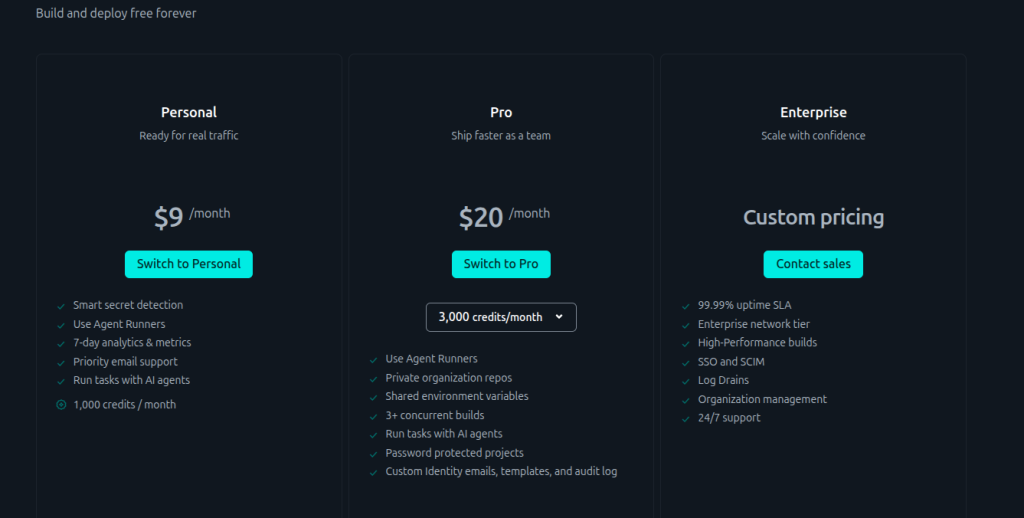
| Personal | $9/month | Individual developers |
| Pro | $20/month | Teams and professional projects |
| Enterprise | Custom | Large organizations |
(Pricing as of July 2026, confirm current figures on Netlify’s pricing page, as usage-based pricing details can change.)
Paid plans run on a credits system that covers build minutes, bandwidth, and compute together rather than billing each separately. The Free plan’s credit allowance suits low-traffic personal projects; Personal and Pro raise the ceiling for active development and real traffic. Upgrading makes sense once you’re deploying frequently, collaborating with a team, or your site’s traffic starts consistently using up the free allowance.
Is Netlify Free Forever?
Yes, Netlify’s free plan doesn’t expire. It’s a genuinely usable tier, not a trial.
Good fits for the free plan:
- Portfolios and personal sites
- Documentation sites
- Side projects and prototypes
When it’s time to pay:
- Traffic grows past the free credit allowance
- You need team collaboration features
- You need capabilities like password-protected sites or advanced analytics
If you’re only ever going to run something small, you may not need to solve the payment problem at all; the free tier is worth trying first.
How to Pay for Netlify From Mauritania Using a Virtual Dollar Card
If you’ve hit the free tier’s limits or need a paid plan from day one, here’s the practical path.
Step 1: Create a Virtual Dollar Card Account
A virtual dollar card functions like a normal Visa or Mastercard at checkout; it has a card number, expiry date, and CVV, but it’s issued digitally and denominated in USD specifically for online use. Developers use them for SaaS subscriptions, cloud services, and other international platforms that a local card can’t reliably bill.
Services like EverTry provide virtual USD cards built for exactly this situation: paying international platforms from a country where a traditional local card often can’t complete the charge. Sign up and complete identity verification to get started.
Step 2: Fund Your Card
Once your account is set up, fund your wallet. Typical options include:
- USDT or USDC (stablecoins) transferred from a crypto wallet
- Supported local funding methods, where available
Keep enough balance for recurring billing; a subscription that fails because the card ran dry causes the same disruption as a declined bank card. Fund a small buffer above the plan price to be safe.
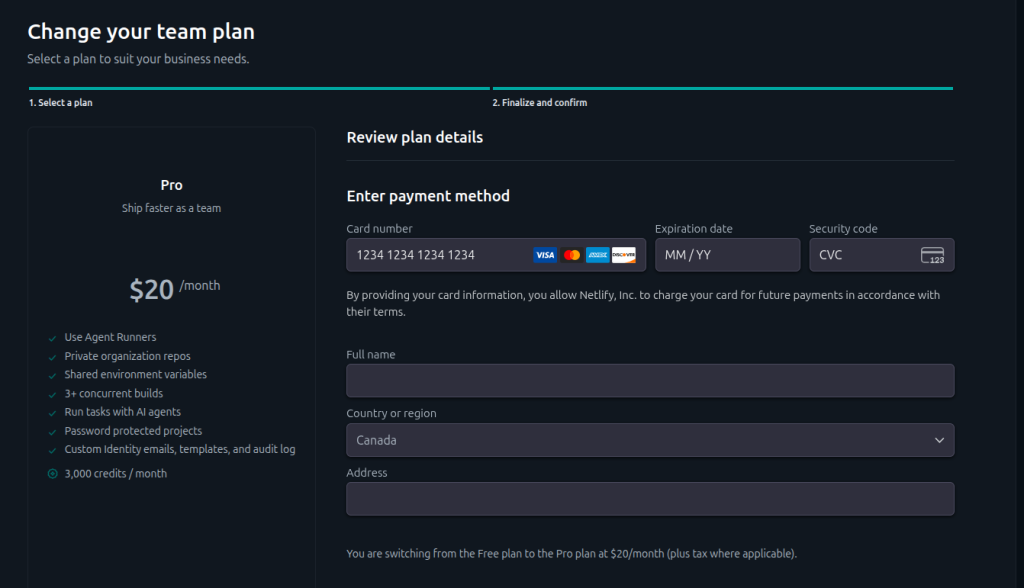
Step 3: Add Your Card to Netlify
- Log in to your Netlify dashboard.
- Open Account Settings.
- Go to Billing.
- Select Add payment method.
- Enter your virtual card’s number, expiry date, and CVV.
- Save and confirm.
Step 4: Confirm Your Subscription
Once the card is accepted, your plan activates immediately. Billing then runs each month automatically against the same card; no need to re-enter details unless the card changes.
Other Things You Can Pay For With a Virtual Dollar Card
The same card that pays for Netlify typically works for other USD-billed developer tools and services, including:
- GitHub subscriptions
- AWS and DigitalOcean
- Vercel
- AI tools and API subscriptions
- Domain registrars
- Online courses
Worth knowing: if Netlify is the first international subscription you’re setting up, it likely won’t be the last.
What Happens If Your Netlify Payment Fails?
A few common causes, and what to do about each:
| Cause | What to check |
|---|---|
| Insufficient balance | Confirm your card’s funded balance covers the plan price plus any buffer |
| Expired card | Check the expiry date on file matches your current card |
| International/recurring payments not supported | Confirm the card can handle foreign-currency recurring charges; this is the core Mauritania issue above |
| Billing details mismatch | Make sure the billing address and name match what you entered at signup |
If a payment fails, Netlify will flag the subscription and may pause site builds until it’s resolved. Update your payment method promptly; the fix is usually quick, but a live client site sitting paused isn’t something to leave overnight.
Netlify Payment Problems: Frequently Asked Questions
What payment method does Netlify use? Netlify bills primarily through international debit and credit cards, Visa, Mastercard, and in some cases American Express.
Can I use a Mauritanian bank card on Netlify? Some cards may work if they support international, recurring USD payments, but many Mauritania-based developers use a virtual USD card instead, since it’s built specifically for this kind of international subscription billing.
Can I pay for Netlify without a credit card? For standard self-service plans (Free, Personal, Pro), a supported card is normally required. Bank transfer is generally reserved for Enterprise agreements.
Can I host a website on Netlify for free? Yes. The free tier is genuinely usable for personal sites, documentation, and prototypes, with no time limit.
Does Netlify work in Africa? Yes. Developers across African countries, including Mauritania, use Netlify for hosting and deploying websites and applications; account creation isn’t restricted by location.
Is Netlify good for developers? Its main strengths are straightforward deployment, built-in CDN hosting, Git-based workflows, and serverless functions, a common choice for both personal projects and production sites.
Final Thoughts: The Easiest Way to Pay for Netlify in Mauritania
Netlify itself is available to anyone, anywhere; the real obstacle for developers in Mauritania is reliable access to USD payment methods, not the platform itself. Once you understand why local cards often can’t settle a recurring dollar charge, the fix is straightforward: use a card built for international, recurring USD billing instead.
For Mauritania-based developers who need that, EverTry provides virtual USD cards that work for Netlify and other international developer tools, funded via USDT/USDC or supported local methods.
Pricing and payment details verified July 2026. Netlify’s pricing and billing requirements can change; confirm current terms at netlify.com/pricing before subscribing.
This guide is for general information only and isn’t financial or legal advice. EverTry is not affiliated with or endorsed by Netlify, Inc.; Netlify is a trademark of its respective owner. Netlify’s pricing, plans, and accepted payment methods described here were accurate as of July 2026 and can change; confirm current terms at netlify.com/pricing before subscribing. Payment success depends on your card issuer’s policies and Netlify’s own processing; EverTry has no control over either. Use of digital assets such as USDT or USDC may be subject to regulations in your jurisdiction.
Matt Aluya is the founder of EverTry. A software engineer focused on virtual card issuance and stablecoin settlement for cross-border payments in emerging markets. LinkedIn · matt.aluya@evertry.co