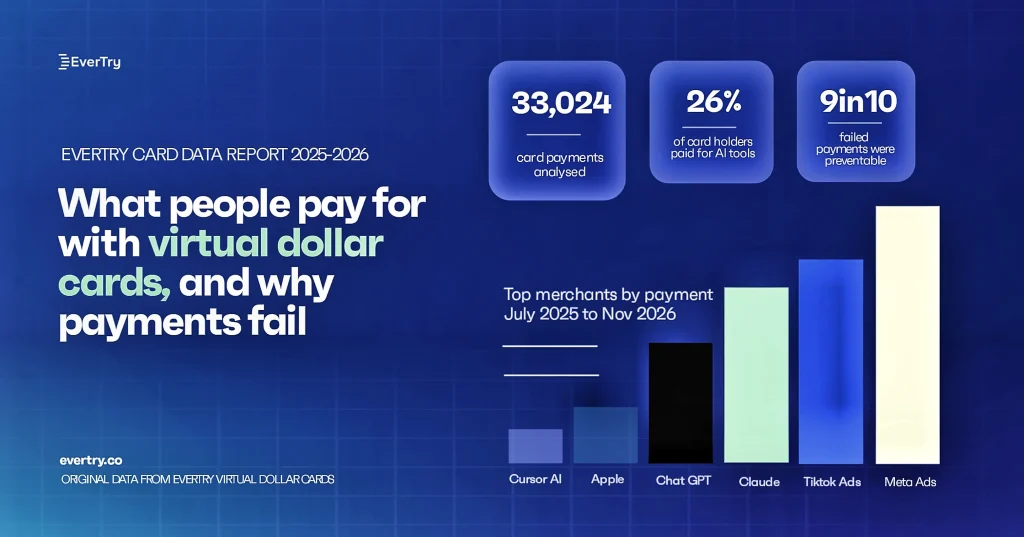
A summary of this report is also published on Condia.
EverTry is a virtual dollar card for people in Nigeria, Ghana, Kenya, Egypt, and other African countries. You fund it in your local currency or in stablecoins, and pay for global services in US dollars. This report looks at 33,024 successful payments and 4,342 declined payment pairs on EverTry cards between July 2025 and November 2026 to answer two questions: what do people pay for in dollars, and why do some of those payments fail?
Key findings
Most dollar spending on EverTry cards is for work, and most failed payments could have been prevented.
- Ads are paid most often. Meta and TikTok ads made up 21% of 33,024 successful EverTry card payments between July 2025 and November 2026.
- AI tools reach the most people. At least 26% of EverTry cardholders paid for an AI tool between July 2025 and June 2026, the largest share of any category.
- Four merchants account for almost 1 in 3 payments. Meta ads, TikTok ads, Claude and ChatGPT together took 10,156 successful payments (31%).
- AI is bought like a subscription, ads like a meter. The median AI tool payment was $20. The median ad payment was under $3.
- About 9 in 10 failed payments came down to balance or an old card. Between June and November 2026, 61% of declined card-and-merchant pairs didn’t have enough balance, and 30% were charges to a card that was no longer active. Risk checks, merchant restrictions, and wrong card details together were under 1 in 10.
- Some merchants keep charging cards long after they’re gone. On average, a merchant tried an inactive card 3.7 times. The most persistent subscription averaged 42 attempts per inactive card.
All figures are for EverTry cards only. Each finding states the period and the measure it uses. See the methodology at the end.
1. What people pay for
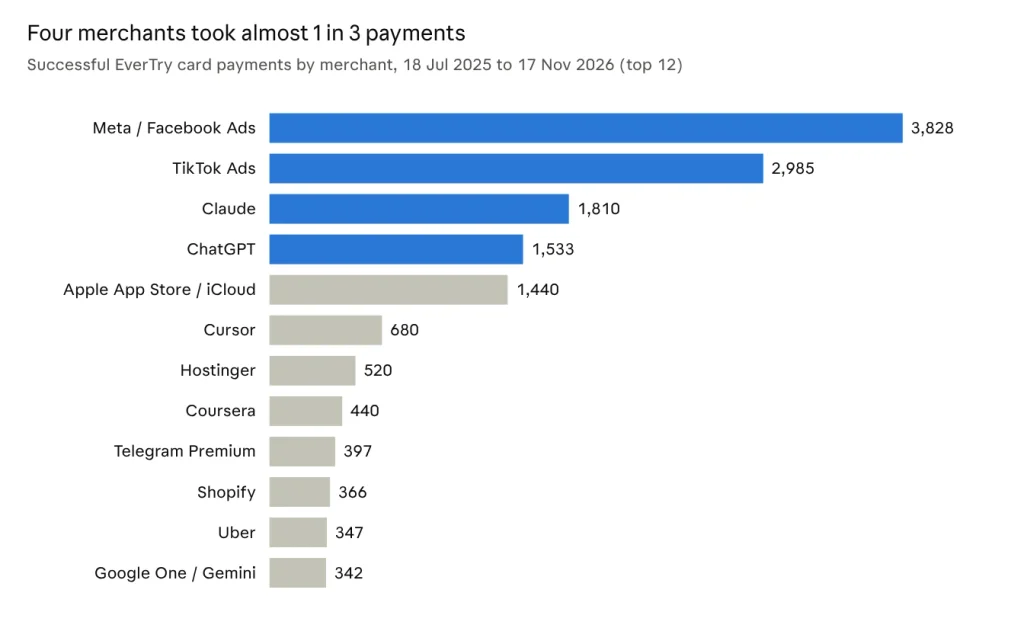
Meta ads, TikTok ads, Claude, and ChatGPT took 31% of all successful payments. Next come Apple’s App Store and iCloud, the AI coding tool Cursor, and a run of tools for learning, building, and selling online, including Hostinger, Coursera, and Shopify.
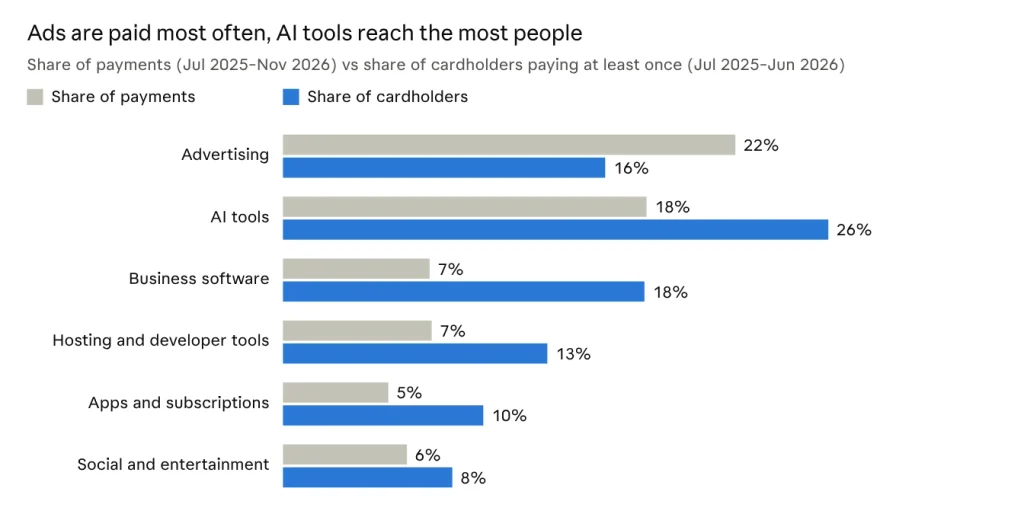
The two measures tell different stories. Ads are paid most often because ad accounts charge in small, frequent amounts. AI tools reach more people: at least 26% of cardholders paid for one, against 16% for ads. Business software follows the same pattern as AI, with many people paying, but only once a month or once a year.
What this means: for EverTry cardholders, paying in dollars is mostly about work. People write and code with AI, reach customers through ads, and run websites and online stores.
2. How people pay
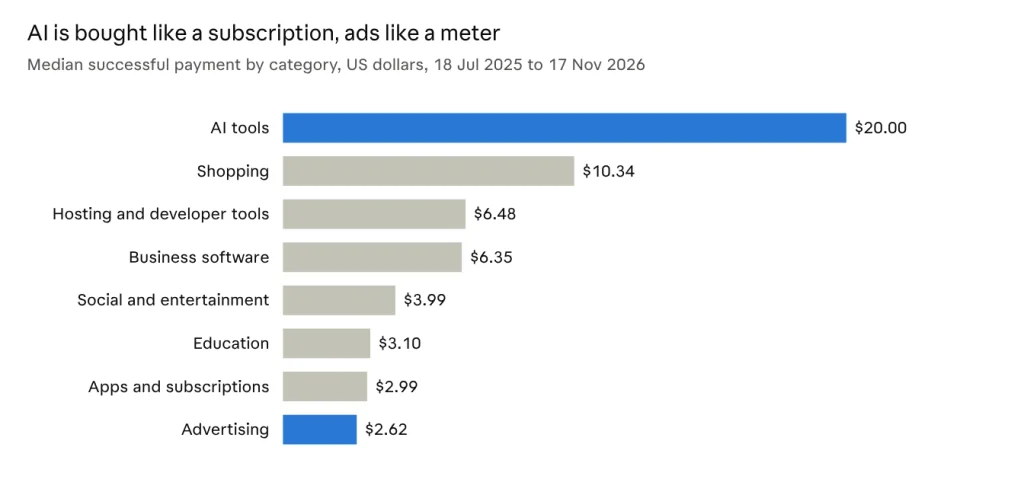
Payment sizes show two different habits.
- AI tools are bought as subscriptions. 35% of all AI tool payments were exactly 20 US dollars, the price of the most common monthly plans.
- Ads are paid like a meter. 68% of ad payments were under 5 US dollars, because ad accounts bill small amounts as campaigns run.
- A few heavy advertisers drive ad volume. A typical ad payer made 4 payments between July 2025 and June 2026, but the average was 15.5, pulled up by a small group who pay many times a month. For AI tools, the average was 5.9.
What this means: the two biggest reasons people need a dollar card behave very differently. AI subscriptions need the right amount on the card once a month. Ad accounts need a steady balance that never runs dry.
3. Why payments fail
A declined payment feels like the card was rejected. In this data, that’s rarely what happened. Merchants retry failed charges, so we counted each card-and-merchant pair once per reason. That stops a single retrying merchant from inflating the numbers.
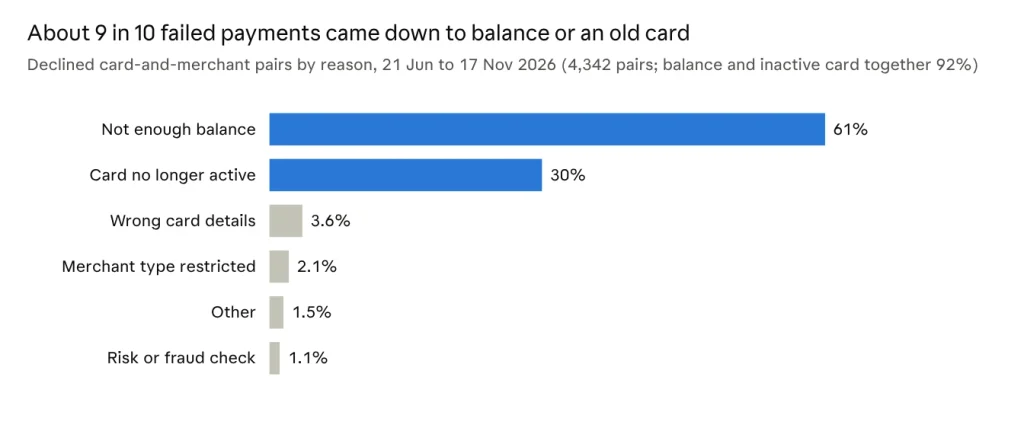
- Not enough balance (61%). The merchant charged before the card was topped up. Subscriptions and ad accounts bill on their own schedule, not when the cardholder remembers to fund.
- Card no longer active (30%). The merchant charged a card that had been deleted or deactivated, often a sign that a subscription was never cancelled inside the service.
- Everything else (under 9%). Wrong card details, merchant types the card can’t be used for, and risk checks.
The pattern holds in every major category. Between 57% and 66% of declined pairs in each category were balance problems, and between 30% and 38% were inactive cards.
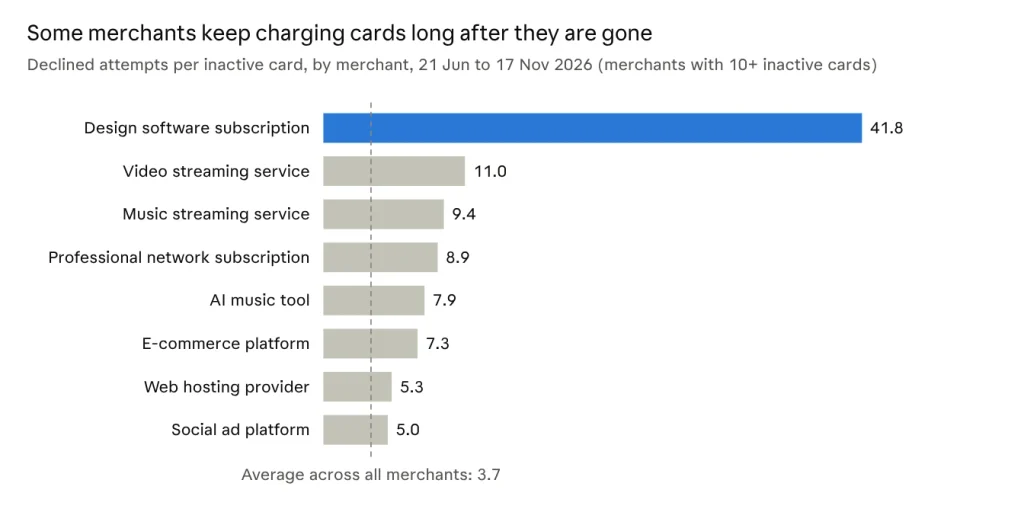
When a card stops working, most merchants try it a few times and stop. Some don’t. On average, a merchant tried an inactive card 3.7 times. A design software subscription averaged 42 attempts per inactive card, and streaming and professional subscriptions averaged around 9 to 11.
What this means: about 9 in 10 failed payments can be prevented. A balance buffer before the renewal date solves the biggest share. Cancelling inside the service, not just deleting the card, solves most of the rest.
These figures cover EverTry cards only. Other cards may show different patterns.
4. How people fund dollar spending
EverTry cardholders don’t need a dollar account to pay dollar prices. They fund a wallet in their own currency, or in stablecoins, and the card pays in US dollars.
| Region | Funding options |
|---|---|
| West Africa | Nigerian naira (NGN), Ghanaian cedi (GHS), West African CFA franc (XOF) |
| East Africa | Kenyan shilling (KES), Ugandan shilling (UGX), Tanzanian shilling (TZS) |
| Southern Africa | South African rand (ZAR), Botswana pula (BWP), Malawian kwacha (MWK) |
| North and Central Africa | Egyptian pound (EGP), Central African CFA franc (XAF) |
| Anywhere | USDT, USDC and BTC |
People pay in by bank transfer, mobile money, or crypto, depending on the country.
5. What this means
For people paying in dollars
- Keep a renewal calendar. List every subscription and ad account that charges your card, with its date and usual amount.
- Fund before the date, with a buffer. Ad accounts need a steady balance. AI subscriptions need the full amount on the day.
- Cancel inside the service. Deleting a card doesn’t cancel a subscription, and some merchants will keep trying for months.
- Separate your spending. One card for ads and another for subscriptions stops a big ad charge from using up your renewal money.
For global companies selling to African customers
- Stop retrying cards that are clearly inactive. Repeated attempts on a dead card don’t recover revenue. They only add noise for card issuers and customers.
- Send a reminder before renewal. Most failed renewals here were balance problems that a reminder could prevent.
- Think about payment size. Small, frequent charges (ads) and fixed monthly charges (AI tools) both work. Large, unexpected annual charges are harder for people who fund their cards as they go.
For the payments ecosystem
- Local-currency funding is the norm. People pay dollar prices without holding dollars.
- AI tools and advertising are the main reasons people need a dollar card, ahead of entertainment and shopping.
About EverTry
EverTry is a virtual dollar card for people in Nigeria, Ghana, Kenya, Egypt, Malawi, and other African countries. You fund it in your local currency or in stablecoins, and pay for global services in US dollars. Cards are US-issued Visa and Mastercard, with a US billing address shown in the app.
We built the EverTry subscription manager because of the pattern in Chapter 3. It reminds cardholders before each renewal: 10 days before monthly or yearly charges and 7 days before weekly ones, by push notification and email. It’s free on active cards. It reminds you, but it doesn’t pay or cancel anything for you.
“When we looked at why payments failed on EverTry cards, the answer was rarely the card itself. Most of the time, a subscription renewed before the card was topped up, or kept charging a card the person had stopped using. So we built the subscription manager to give people a heads-up before every renewal, because the easiest failed payment to fix is the one that never happens.”
Matt Aluya, Founder, EverTry
EverTry is FinCEN-registered and offers 24/7 support. Learn more about how EverTry’s virtual dollar card works.
Methodology
Data. The report uses anonymised, aggregated EverTry card data from two internal sources: a record of successful card payments (18 July 2025 to 17 June 2026) and a log of card events, including approvals and declines with reason codes (21 June to 17 November 2026). No individual user’s data is shown, and any figure based on fewer than 10 cardholders is left out.
Measures.
- Successful payments: approved card charges, counted once each. 33,024 in scope, from 18 July 2025 to 17 November 2026.
- Cardholders: unique users who made at least one payment in a category. 2,462 cardholders, available from 18 July 2025 to 17 June 2026 only.
- Declined pairs: unique combinations of card, merchant and decline reason, from 21 June to 17 November 2026 (4,342 pairs). This stops a merchant that retries many times from inflating the numbers. Retry intensity is reported separately.
- Payment size: the median of successful payments, in US dollars, excluding zero-value authorisations.
Merchant grouping. Raw merchant descriptors were cleaned (location, phone number and prefixes removed) and matched to brands, then to categories, using rules. About 23% of payments went to smaller merchants that weren’t matched, so category shares are minimums.
Exclusions. Card verification holds, cross-border fee lines, adult content, and internet service payments made through foreign regional merchants were removed before analysis.
Limitations.
- The data covers EverTry cards only, so it isn’t a sample of all card users in Africa.
- The two sources cover back-to-back periods and hold different fields. Cardholder figures stop in June 2026, and payment volume falls in mid-2026 when the data moves from one source to the other, so this report doesn’t show trends over time.
- “Card no longer active” includes cards closed by the cardholder and cards deactivated for other reasons.
- Payment counts aren’t values. One large payment and one small payment count the same.
How to cite this report
Source: EverTry Card Data Report 2025–2026, EverTry, November 2026. evertry.co/blog/evertry-card-data-report-2025-2026
Journalists and researchers who’d like the aggregated figures, or more detail, can contact press@evertry.co
Matt Aluya is the founder of EverTry. A software engineer focused on virtual card issuance and stablecoin settlement for cross-border payments in emerging markets. LinkedIn · matt.aluya@evertry.co