
The fastest fix is a virtual dollar card, funded with NGN, USDT, or USDC, added at checkout the same way you’d add any other card. With EverTry, the whole process takes under 15 minutes. Nigerian cards are still getting declined on Hostinger in 2026, even though Hostinger now has a Naira-priced site for Nigeria.
Your website, your client’s site, or your side hustle’s landing page shouldn’t be sitting there unpaid because a bank flagged your card. Here’s exactly what changed, what didn’t, and how to fix it.
What’s New: Hostinger Launched Officially in Nigeria
In December 2025, Hostinger officially expanded into Nigeria, offering local payments and AI-powered tools aimed at individuals and small businesses building an online presence. The launch lets Nigerian customers pay in naira directly, removing what had been a major friction point for local businesses relying on local payment methods.
Why Do Nigerian Cards Still Get Declined on Hostinger?
Even with the new Nigeria site, declines are still common. It’s rarely a balance problem. The usual culprits:
- CBN spending caps. Nigerian banks still enforce monthly limits on international or foreign-currency card spend. A card that works for one purchase can fail on the next if you’re near that ceiling.
- Currency/region detection mismatches. If Hostinger’s checkout puts you on the global (USD) site instead of hostinger.ng, your Naira card gets treated as an international payment, the same failure mode as before the Nigeria launch.
- Fraud and risk filters. Nigerian IP addresses paying an international-facing platform can still trigger automated fraud flags on the card network or merchant side, regardless of which currency you’re billed in.
- Multi-year plans and add-ons. Domains, upgrades, and long-term hosting terms are charged as one lump sum. Larger one-time charges are more likely to hit a spending cap than a small recurring renewal.
- Unsupported card types. Not every card that looks like a Visa or Mastercard is actually enabled for the transaction type Hostinger’s payment processor expects.
None of this means you did anything wrong. It means you need a payment method built for this exact problem.
What Payment Methods Does Hostinger Accept?
| Payment method | Available in Nigeria? | Reliability |
|---|---|---|
| Naira Visa/Mastercard (hostinger.ng) | Yes | Medium subject to CBN caps |
| OPay (hostinger.ng) | Yes | Medium |
| International Visa/Mastercard/Amex/Discover/JCB/DinersClub (hostinger.com) | Limited | Medium to Low |
| PayPal, Apple Pay, Google Pay, AliPay | Depends on the linked card | Medium |
| Cryptocurrency | Yes | High |
| Virtual dollar card | Yes | High |
On the global site, Hostinger accepts Visa, Mastercard, Amex, Discover, JCB, and DinersClub cards, plus PayPal, Apple Pay, Google Pay, and AliPay as eWallets, and a broad range of cryptocurrencies. On the Nigeria-specific site, the accepted rails are narrow to Naira debit/credit cards and OPay. The catch for Nigerian users: whichever checkout you land on, your card still has to clear CBN’s international/foreign-currency restrictions if it’s flagged as a cross-border transaction which is exactly the problem a virtual dollar card solves.
The Fastest Way to Pay: A Virtual Dollar Card
A virtual dollar card is a USD-denominated Visa or Mastercard that exists only digitally. You fund it in naira or stablecoins, and it works anywhere a normal international dollar card would, including both Hostinger’s global and Nigeria checkout pages.
Why Nigerians specifically prefer this route over a domiciliary account or hoping the Naira card clears:
- No bank visit, no paperwork, no multi-day approval wait.
- Works for recurring billing: if you’re on a monthly plan or add a domain later, your card stays funded and ready.
- If you already earn in USDT (common for freelancers and remote workers), you can fund the card directly, skipping a Naira conversion round trip.
- One card works across every platform you pay for internationally, not just Hostinger.
Why EverTry Works Well for This
- Fund with NGN, USDT, or USDC, whichever you actually have.
- Card creation in under 15 minutes, start to finish.
- No bank trip, no phone calls to customer care.
- Beyond the card: USD/EUR/GBP accounts and stablecoin wallets are useful if Hostinger isn’t the only international bill you’re juggling.
Example: a freelance web designer who gets paid in USDT for client work can fund an EverTry card straight from that balance and pay for a client’s Hostinger plan the same day no need to first cash out to Naira and back.
Step-by-Step: Pay for Hostinger Using EverTry
Create your EverTry account. Sign up with your name, email, and phone number.
Complete verification (KYC). Upload a valid ID and complete the quick selfie check. Make sure the name matches your sign-up details exactly; this is the most common reason verification gets delayed.
Fund your wallet. Choose NGN (bank transfer), USDT, or USDC, depending on what you’re holding.
Create your virtual dollar card. Card details (number, expiry, and CVV) are issued instantly inside the app.
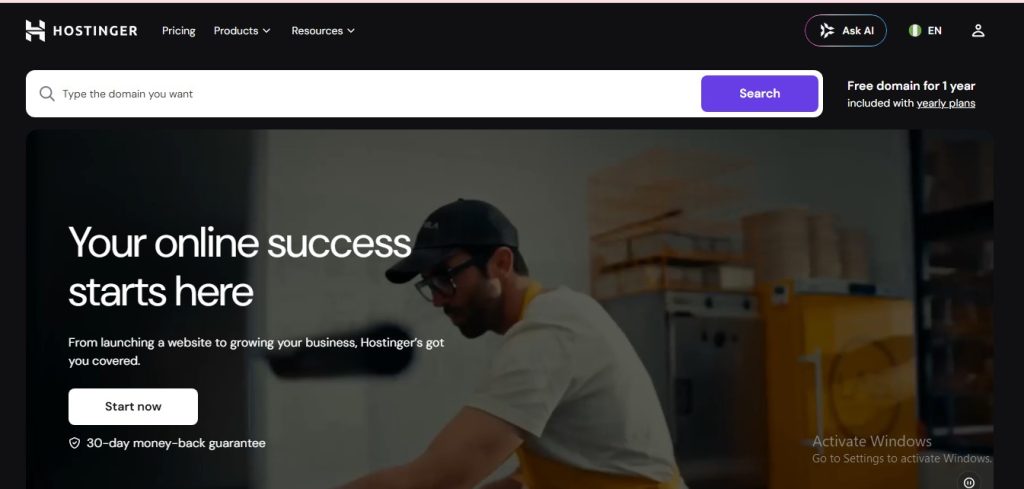
Go to Hostinger and choose your plan. You can use either hostinger.com or hostinger.ng; the global USD checkout tends to have the widest plan selection.
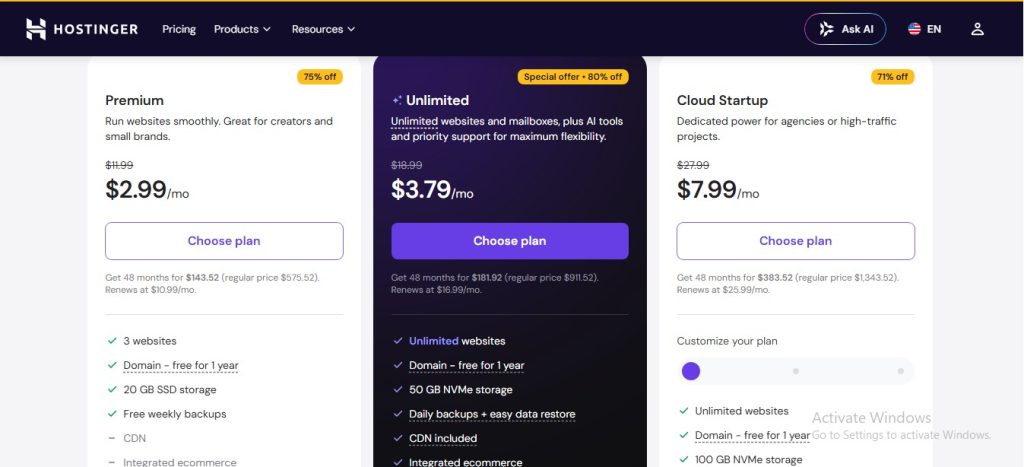
At checkout, enter your EverTry card details exactly as shown in the app, and make sure the billing address matches your EverTry profile.
Confirm payment. Hostinger may take a few minutes to fully process the charge that’s normal, not an error.
That’s it. Once your card is saved, future renewals charge automatically, the same as any other card on file.
Current Hostinger Pricing (2026)
Prices below are current as of mid-2026 based on published rates; always confirm live pricing at checkout before budgeting, since promotional pricing changes periodically and varies by region and plan length.
| Plan | Introductory rate | Typical renewal rate | Best for |
|---|---|---|---|
| Premium (Shared/WordPress) | ~$1.99–2.69/mo | ~$10.99–12.99/mo | First website, portfolio, small blog (up to 3 sites) |
| Business (Shared/WordPress) | ~$2.99–3.49/mo | ~$16.99/mo | Growing sites, up to 50 sites, NVMe storage |
| Cloud Startup | ~$6.99–9.99/mo | ~$25.99/mo | Higher-traffic sites (50k+ monthly visitors), up to 100 sites |
| VPS | from ~$4.99–5.84/mo | ~$11.99/mo | Developers needing dedicated resources, 24-month max term |
A few things worth knowing before you buy:
- Long-term plans are billed upfront as a lump sum, not monthly. A 48-month plan means one large charge today, not a recurring small one.
- Renewal pricing is significantly higher than the intro rate, often more than 5x. Hostinger shows the renewal price and date at checkout, so it’s worth actually reading that screen before you confirm.
- No overage charges if you exceed bandwidth or CPU limits; Hostinger throttles your connection instead of billing extra.
- Most Hostinger products can be refunded within 30 days of the transaction date if not paid with cryptocurrency, though domains and some add-on services follow different, often stricter, rules.
Which Hostinger Plan Should You Choose?
- First blog, portfolio, or resume site → Premium plan. Affordable, includes a free domain, and is fine for 0–10,000 monthly visitors.
- Growing business site or small store → Business plan. NVMe storage, more sites, better performance headroom.
- High-traffic site or store (50k+ visitors/month) → Cloud Startup. Dedicated IP, more PHP workers, and priority support.
- Full control over server resources → VPS, if you’re comfortable managing your own environment.
Is Hostinger Cheaper Than Alternatives?
Hostinger’s entry pricing is aggressive compared to most global hosts, and it’s consistently rated among the top budget options for 2026. The tradeoff is the renewal jump described above factor the full 4-year cost into your decision, not just the advertised monthly rate, especially if you’re converting Naira to fund the purchase.
Frequently Asked Questions
Didn’t Hostinger just launch in Nigeria with Naira payments? Do I still need a virtual card? Only if your Naira card gets declined. Hostinger’s Nigeria site accepts Naira Visa/Mastercard and OPay directly, but CBN spending limits, fraud filters, and currency-detection issues can still cause declines, especially for larger or longer-term plans. A virtual dollar card is the backup that works either way.
Why is my Naira card not working on Hostinger? Usually a CBN-imposed cap on international or foreign-currency transactions, a currency mismatch if you’re on the wrong regional checkout, or a fraud flag, not usually an account balance issue.
Can I use a virtual card to pay for Hostinger? Yes. A virtual dollar card like EverTry works exactly like a normal international Visa or Mastercard at checkout, on either hostinger.com or hostinger.ng.
Is EverTry safe to use? Yes, EverTry uses encryption and KYC verification to protect your account and transactions.
How much does Hostinger cost per month? Introductory rates run roughly $1.99–$9.99/month depending on plan (Premium, Business, or Cloud Startup) and commitment length, with renewal pricing significantly higher. See the pricing table above for current tiers.
What payment methods does Hostinger accept in Nigeria? Naira Visa/Mastercard and OPay via hostinger.ng, or the full global range (international cards, PayPal, Apple Pay, Google Pay, AliPay, crypto) via hostinger.com.
Does Hostinger offer refunds if I change my mind? Most hosting plans qualify for a refund within 30 days of purchase if not paid with cryptocurrency. Domains and some add-ons follow different, often non-refundable, rules that check the current policy before you buy.
Can Nigerians pay for Hostinger without a domiciliary account? Yes. A virtual dollar card funded with NGN, USDT, or USDC removes the need for a domiciliary account entirely.
Which Hostinger plan is best for a beginner in Nigeria? The Premium plan is the most affordable, includes a free domain, and comfortably handles a first website or portfolio.
What happens if my Hostinger payment fails after my site is already live? Your hosting can be suspended if a renewal invoice goes unpaid. Keep your funding source (Naira balance or stablecoin wallet) topped up ahead of your renewal date, especially for client or business sites.
Beyond Hostinger: Other Platforms You Can Pay With the Same Card
A virtual dollar card built for Hostinger works just as well for the rest of your stack: Namecheap, DigitalOcean, and GitHub all bill in USD to the same kind of card.
Many people building an online business end up consolidating several international subscriptions onto one payment method instead of juggling separate workarounds for each. EverTry’s USD, EUR, and GBP accounts and stablecoin wallets exist for exactly that useful once Hostinger isn’t the only international bill on your plate.
Final Thoughts
Hostinger’s Nigeria launch is a real step forward, and Naira pricing plus OPay support genuinely helps. But it doesn’t remove the underlying CBN restrictions that have made “card declined” a familiar message for Nigerian users of any international platform. If that happens to you, a virtual dollar card from EverTry gets you past checkout in minutes on Hostinger or anywhere else you pay in dollars.
Hostinger and related names are trademarks of their respective owners. This article was independently researched and written by EverTry and is not sponsored by, affiliated with, or endorsed by Hostinger. Pricing, payment methods, and policies mentioned here reflect publicly available information at the time of writing and may change always confirm current details on Hostinger’s official site before making a purchase decision..
Jamilah is a digital marketer focused on fintech growth, SEO, and user acquisition.
She works on content and campaigns that help users navigate cross-border payments more easily.
At EverTry, she supports marketing initiatives aimed at making global payments simpler and more accessible.